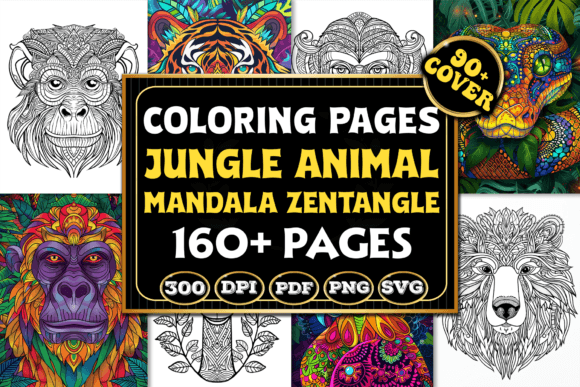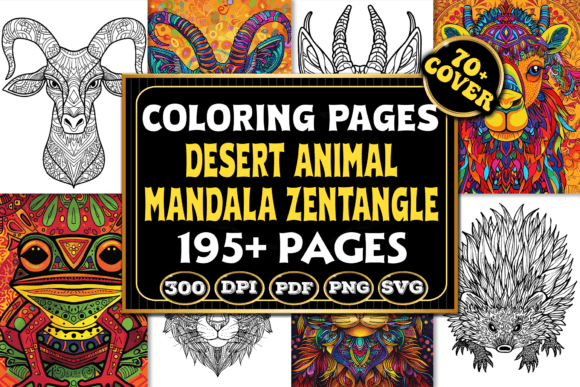
Pets Animal Mandala Zentangle Coloring
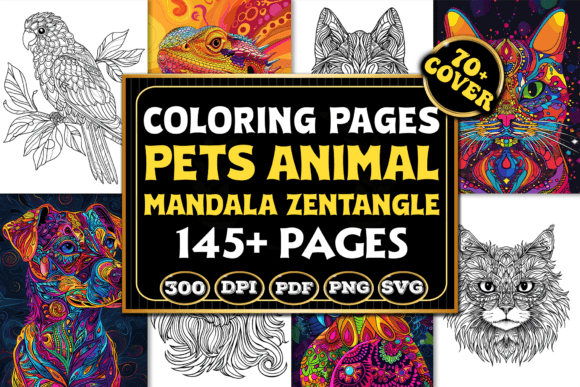
There’s something quietly powerful about combining the soothing repetition of Zentangle patterns with the joyful familiarity of pets—and wrapping them both in the sacred symmetry of mandalas. Pets Animal Mandala Zentangle Coloring isn’t just another trend; it’s a thoughtful fusion of mindfulness, artistic expression, and emotional connection. Whether you’re sketching a dachshund wrapped in interlocking florals or tracing a cat’s face inside a radial geometric frame, each page invites focus without demanding expertise. That’s why adults—from busy educators needing mental reset moments to freelance designers sourcing fresh assets—keep returning to this niche.
What many assume—but shouldn’t—about file formats and usability
A common oversight happens before the first page is even printed: assuming “PDF included” means full flexibility. In reality, not all PDFs are created equal. Some bundles deliver flattened, non-editable PDFs—fine for printing, but useless if you want to isolate elements for digital overlays, social media graphics, or custom KDP cover mockups. Worse, others label files as “SVG” while embedding rasterized outlines, making them unscalable without pixelation.
This misstep directly affects your workflow. Say you’re building a coloring book for Etsy and need to adjust line weight for laser-cut stencils. If your SVG files don’t retain vector paths—or worse, open as blank or distorted layers in Illustrator—you’ll waste hours re-tracing or scrapping assets entirely. The same goes for PNGs: low-resolution exports (under 300 DPI) blur when scaled for large-format prints or merch mockups, undermining perceived quality before a single sale.
Here’s what to verify before downloading or purchasing:
- Confirm SVG files open cleanly in vector editors (e.g., Adobe Illustrator or Affinity Designer) with editable strokes and grouped layers—not embedded JPEGs masquerading as vectors.
- Check PNGs are saved at 300 DPI minimum and include transparent backgrounds (not white fills), so they layer smoothly over cover backgrounds or marketing visuals.
- Ensure the final PDF interior is truly “bleed-free” and sized precisely to 8.5” × 11”—no hidden margins or cropping that shift composition when printed on standard home or KDP printers.
Why “70 cover backgrounds” matters more than it sounds
It’s easy to skim past cover assets—after all, you only need one front cover, right? But professionals know variety isn’t about excess; it’s about iteration and audience alignment. A watercolor-textured background may resonate with wellness bloggers, while a clean, minimalist gradient suits productivity coaches launching a “calm focus” journal series. Having 70 high-resolution options means you can A/B test thumbnails on Amazon KDP, match seasonal branding (think warm amber tones for fall launches), or repurpose backgrounds across email headers, Canva templates, or Pinterest pins—without licensing friction or resizing compromises.
The mistake? Assuming all 70 are interchangeable. Some bundles include near-duplicates—slight hue shifts or minor scale changes—that offer no real design advantage. Instead, look for intentional diversity: subtle textures, bold gradients, organic ink blots, soft grain, and matte finishes. These differences impact how your book feels *before* it’s opened—critical when competing in crowded categories like adult coloring or pet-themed journals.
How interior consistency impacts user experience—and sales
Every coloring book buyer scans interiors before buying. They’re checking for clarity, rhythm, and visual breathing room. With Pets Animal Mandala Zentangle Coloring, line weight consistency is non-negotiable. Too-thin lines vanish on economical paper; too-thick ones bleed or overwhelm delicate mandala details. And if some pages use tight, intricate linework while others go sparse and sketchy, users feel whiplash—not flow.
This inconsistency doesn’t just frustrate colorists—it erodes trust. A teacher ordering bulk copies for a classroom art therapy session won’t risk uneven pages confusing beginners. A marketer promoting “stress relief through structure” can’t justify chaotic spacing or mismatched animal poses (e.g., a symmetrical owl facing left on page 12, then right on page 13 without reason).
The fix is simple but often skipped: preview at least 10–15 consecutive interior pages—not just thumbnails. Look for:
- Uniform stroke thickness (ideally 0.5–0.8 pt for crisp black-and-white printing)
- Consistent negative space around each pet-mandala composition (no cramped corners or awkward cut-offs)
- Logical progression—e.g., simpler animals (bunny, fish) early on, gradually introducing layered complexity (parrot with feather mandalas, sleeping dog with nested geometric paws)
Realistic expectations for digital reuse—and where limitations lie
If you plan to sell digital downloads, resell as editable Canva templates, or integrate into online courses, clarify usage rights *before* purchase. Not every bundle permits commercial redistribution—even with “KDP interior” in the title. Some restrict resale to physical books only, or forbid SVG edits for derivative products. Violating these terms risks takedowns, lost revenue, or damaged reputation.
A better approach? Choose bundles explicitly labeled “Commercial Use – Extended License,” with clear documentation on permitted outputs (e.g., “You may modify and resell as printable PDFs, PNG overlays, or SVG-based digital kits”). Then, test one file across your intended platforms: upload an SVG to Canva, check resolution in a Google Slides presentation, print a sample page on your target paper stock. Real-world testing reveals gaps no description can predict.
Final checklist before you commit
Before adding Pets Animal Mandala Zentangle Coloring to your cart—or finalizing your own KDP launch—ask yourself:
- Is every file type actually usable in my tools? Open one SVG, one PNG, and the PDF in your usual software. Do layers unlock? Does text stay sharp at 200% zoom?
- Does the animal variety reflect real audiences? Are there inclusive representations—not just dogs and cats, but rabbits, turtles, hedgehogs, birds, and gentle reptiles—to broaden appeal beyond “typical” pet lovers?
- Are line weights and spacing optimized for both digital stylus use *and* pencil-on-paper? Fine details should remain legible on tablets, yet bold enough for broad-tip markers.
- Do cover backgrounds support branding—not just decoration? Can you overlay text without contrast loss? Do light/dark variants exist for accessibility?
When chosen well, Pets Animal Mandala Zentangle Coloring does more than fill pages. It builds calm. It sparks creativity without pressure. And for creators, it becomes reliable, adaptable infrastructure—supporting everything from self-care apps to boutique stationery lines. The difference between good and great isn’t in the number of files, but in how thoughtfully each one serves its purpose.