The Mega KDP Interiors Coordinate Plane Bundle
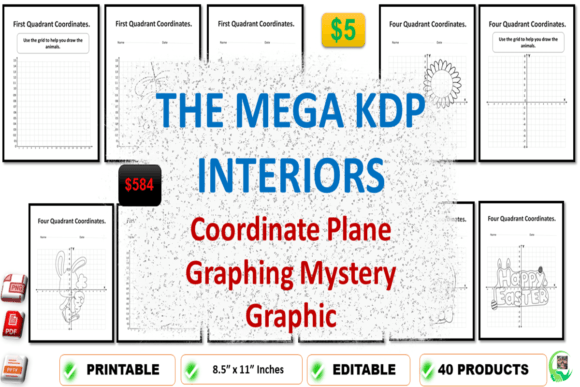
If you're creating printable math resources for classrooms, homeschooling, or KDP interiors publishing, The Mega KDP Interiors Coordinate Plane Bundle is a smart, time-saving asset—but only if you understand what it actually delivers and how to use it effectively. This isn’t a generic graphing workbook. It’s a curated collection of 40 ready-to-print coordinate plane mystery pictures designed specifically for educators, content creators, and KDP sellers who need clean, professional, classroom-tested materials—without reinventing the wheel.
Each activity focuses on plotting ordered pairs using whole-number coordinates only—no fractions, no decimals. That means students build confidence with foundational graphing concepts before tackling more complex number systems. You can choose between first-quadrant (positive whole numbers only), first-quadrant line graphs, or full four-quadrant practice—all clearly labeled and visually distinct. That flexibility matters: many teachers accidentally assign four-quadrant activities too early, causing unnecessary frustration. This bundle helps you scaffold intentionally.
Common Missteps—and Why They Cost Time and Clarity
One frequent oversight? Assuming “coordinate plane bundle” means instant plug-and-play for all grade levels. In reality, The Mega KDP Interiors Coordinate Plane Bundle assumes learners already know how to read axes and interpret (x, y) notation. If your students are still mixing up x- and y-coordinates—or miscounting grid lines—the mystery picture won’t magically fix that. Use the included first-quadrant-only pages as warm-ups, not assessments, until fluency is established.
Another subtle but costly mistake: overlooking file types and print specs. The bundle includes high-resolution PDFs with bleed, meaning artwork extends to the edge of the page—ideal for professional interior design–themed KDP interiors books. But if you’re printing at home or using a basic printer without bleed support, you might unintentionally crop key parts of the grid or title. Always open the PDF in Adobe Acrobat (not just a browser) and check “Actual Size” view before sending to print. Also verify your printer settings match the document’s orientation (portrait vs. landscape)—some mystery pictures span two pages, and incorrect scaling will distort spacing.
Creators sometimes assume the PPT source files let them freely edit *everything*. While true for text, colors, and layout, the coordinate grids themselves are locked vector elements—not editable point-by-point. You can’t change individual grid line thickness or shift axis labels mid-document without breaking alignment. Instead of forcing edits, use the PPT files to annotate: add teacher notes, highlight common errors (“Remember: x comes first!”), or insert answer keys directly onto slides for digital instruction.
What to Verify Before You Buy or Use
Before adding The Mega KDP Interiors Coordinate Plane Bundle to your cart—or assigning it to students—check these three things:
- Your audience’s readiness: Are they comfortable with positive integers on both axes? If not, start with Book 1–5 (first quadrant only) and delay four-quadrant work until they consistently plot (3, 7) correctly—not (7, 3).
- Your output goal: Need physical handouts? The bleed-enabled PDFs are perfect. Building a digital lesson? Use the PNGs for clear, fast-loading visuals in Google Slides or Canva. Creating a KDP interior? Confirm your book dimensions match the PDF’s page size (standard 8.5" × 11" unless noted otherwise).
- Your customization needs: The PPT files give you control over fonts, instructions, and branding—but don’t expect to restructure the core graphing logic. If you need custom coordinate ranges (e.g., x from –15 to +15 instead of –10 to +10), plan to build those separately or adjust answer keys manually.
Better Approaches for Real Results
Instead of treating this as “just another worksheet pack,” integrate it strategically. For example: use the mystery pictures as self-checking exit tickets. Students plot points, then compare their completed image to the answer key (included). If the cat’s ear is missing, they know exactly which point was plotted wrong—no grading required. That builds metacognition faster than traditional worksheets.
For KDP sellers, avoid stacking all 40 images into one low-content book. Group them by skill: “First Quadrant Fun,” “Four-Quadrant Challenges,” or “Holiday-Themed Graphing.” Each themed mini-book performs better in search and converts higher than a massive, unfocused volume. And because all coordinates use whole numbers, you’ll get fewer negative reviews about “confusing fractions”—a real pain point in competing bundles.
Early finishers? Assign a mystery picture with an intentional twist: “Plot these points, then reflect the image across the y-axis and record the new coordinates.” That extends learning without extra prep—and leverages the clean, uncluttered grid design built into every page.
Final Thought: Value Isn’t Just in Quantity
Yes, there are 40 activities—and yes, the price is just $5 (saving $579 off the hypothetical full value). But the real value lies in consistency: same grid style, same labeling convention, same visual clarity across all 40. That uniformity saves hours of formatting, reduces student cognitive load, and makes differentiation seamless. It’s not about filling pages—it’s about delivering predictable, pedagogically sound practice.
So before you download, ask: Does this align with where my students are *right now*? Does it match how I plan to deliver it—print, digital, or published? And most importantly: does it let me focus on teaching, not troubleshooting? With The Mega KDP Interiors Coordinate Plane Bundle, the answer can be yes—if you use it with intention.