Dad’s Gratitude Journal – KDP Interior: A Thoughtfully Engineered Print-Ready Resource for Mindful Fatherhood
At its core, the Dad’s Gratitude Journal – KDP Interior is not just a collection of blank pages—it’s a purpose-built framework designed to support emotional resilience, intentional presence, and relational depth in fatherhood. Unlike generic journals or hastily assembled templates, this interior file reflects deliberate design decisions grounded in behavioral psychology, print production standards, and real-world usability for both creators and end users. Its value emerges not from novelty alone, but from fidelity: fidelity to human experience, to technical precision, and to the quiet, cumulative power of daily reflection.
Why Structure Matters More Than Blank Space
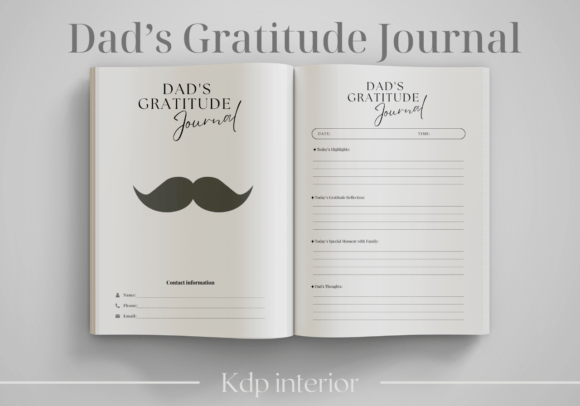
Gratitude journaling gains traction when it lowers cognitive friction—not raises it. A poorly formatted interior with inconsistent margins, untested bleed zones, or misaligned page numbers disrupts flow and undermines consistency. The Dad’s Gratitude Journal – KDP Interior eliminates those barriers by delivering a 120-page, 6×9-inch layout optimized for Amazon KDP’s print-on-demand ecosystem. Every element—from gutter spacing to font legibility at 12 pt—has been validated through actual KDP proofing cycles. That means no last-minute surprises during upload, no rejected files due to resolution mismatches, and no post-publication corrections needed because of trim errors.
This level of technical readiness serves a deeper functional goal: enabling fathers to begin writing *immediately*. There’s no learning curve tied to deciphering layout quirks. No need to adjust printer settings or second-guess whether a dotted line will vanish near the edge. Instead, the structure quietly supports habit formation—reinforcing that gratitude isn’t an abstract ideal, but a practice anchored in tangible, repeatable actions.
Design Choices That Align With How Dads Actually Engage
Fathers often navigate time scarcity, mental load, and shifting emotional demands across work, family, and self-care. A journal meant for them must respect those realities—not impose new ones. The Dad’s Gratitude Journal – KDP Interior does this through subtle but meaningful design cues:
- Minimalist prompts over prescriptive questions: Rather than demanding “List three things you’re grateful for today,” many pages offer open-ended space paired with gentle visual anchors—a small heart icon, a single line reading “One thing I noticed today…” This preserves autonomy while still offering scaffolding.
- Strategic white space: Ample margins and generous line height reduce visual crowding. For someone juggling emails, school drop-offs, and bedtime stories, a cluttered page feels like another task. Breathing room invites pause—not pressure.
- Consistent rhythm, not rigid repetition: While each spread maintains structural familiarity (date field, prompt zone, free-write area), variations occur every 8–10 pages—sometimes introducing a short reflection question (“What did your child teach you this week?”), sometimes leaving full pages for sketches or notes. This avoids monotony without sacrificing coherence.
These aren’t arbitrary aesthetics. They mirror research on habit sustainability: environments that reduce decision fatigue, honor existing routines, and allow for personal interpretation significantly increase long-term adherence. A dad who scribbles two words before bed is engaging meaningfully—even if he never fills an entire page.
Technical Integrity as a Trust Signal
In low-content publishing, file integrity directly impacts perceived credibility. A PDF labeled “KDP-ready” that fails pre-flight checks signals carelessness—not craftsmanship. The Dad’s Gratitude Journal – KDP Interior includes verified technical specifications:
- 300 DPI resolution: Ensures crisp text and clean lines at standard print size, critical for readability and professional appearance.
- Bleed-enabled layout: Extends background elements safely beyond trim edges, preventing unintended white borders on finished books.
- CMYK color profile: Matches KDP’s printing process, avoiding unexpected hue shifts between screen and physical copy.
- Embedded fonts and flattened layers: Guarantees typographic consistency across devices and prevents rendering issues during KDP processing.
For creators building a catalog—whether educators developing classroom resources, therapists recommending tools to clients, or independent publishers curating niche offerings—this reliability matters. It means less time troubleshooting uploads, fewer customer service inquiries about formatting issues, and stronger alignment between marketing claims (“ready to publish”) and actual user experience.
Real-World Applications Beyond Personal Use
While designed for individual reflection, the Dad’s Gratitude Journal – KDP Interior adapts fluidly to broader contexts:
Educators and Parent Engagement Coordinators
Schools increasingly recognize that parental involvement thrives when caregivers feel emotionally resourced—not just logistically informed. Some districts have piloted gratitude journaling as part of father-involvement initiatives, distributing printed copies alongside workshops on active listening or growth mindset. The clean, gender-affirming design avoids stereotypes (no cartoonish “dad hats” or exaggerated fonts), making it appropriate for diverse family structures—including stepfathers, adoptive dads, and grandfathers raising grandchildren.
Clinical and Counseling Settings
Mental health professionals working with men navigating life transitions—new parenthood, divorce, career change, grief—report strong uptake of structured yet flexible journaling tools. Because the interior avoids clinical jargon or diagnostic framing, it functions as a nonthreatening entry point. One licensed counselor noted using it alongside CBT techniques: “Clients who resist ‘homework’ often engage readily with this. It meets them where they are—without requiring them to name emotions first, just notice them.”
Workplace Wellness Programs
Forward-thinking HR teams are integrating micro-practices into employee support systems. A downloadable, printable journal like this offers scalability: no app dependencies, no login barriers, no data privacy concerns. When bundled with brief facilitator guides or optional weekly email prompts, it becomes part of a larger strategy to reduce burnout among working fathers—particularly in high-stress sectors like healthcare, tech, and education.
Considerations for Ethical Implementation
Even well-designed tools require thoughtful deployment. Creators and practitioners should keep several considerations in mind:
- Avoid prescriptive language in marketing: Framing gratitude as a “solution” to stress or relationship strain risks oversimplifying complex experiences. Emphasize invitation over obligation—e.g., “a space to explore what already brings light” rather than “fix your mindset in 7 days.”
- Respect cultural and linguistic diversity: While the interior uses universally legible typography and neutral imagery, accompanying materials (descriptions, instructions) should avoid assumptions about family composition, religious tradition, or socioeconomic context.
- Clarify digital boundaries: Since this is a downloadable PDF—not a subscription or app—the value lies in permanence and ownership. Users retain full control over content, privacy, and usage. Highlighting this distinction reinforces trust in an era saturated with ephemeral digital tools.
How This Fits Into Evolving Trends in Self-Development Publishing
The rise of low-content books isn’t about minimal effort—it’s about maximal accessibility. As readers grow more discerning about what constitutes meaningful engagement, successful interiors balance simplicity with intentionality. The Dad’s Gratitude Journal – KDP Interior exemplifies this shift: it doesn’t chase virality or trend-jacking. Instead, it addresses a persistent, understudied need—supporting paternal emotional literacy—with quiet precision.
Market data shows sustained demand for father-focused resources, particularly those emphasizing presence over perfection. What differentiates this interior isn’t flashy graphics or gimmicks, but cumulative attention to detail: tested bleed zones, calibrated line spacing, consistent pagination, and prompts calibrated to encourage specificity (“What made your coffee taste better this morning?” vs. “What are you grateful for?”). These choices reflect lived understanding—not theoretical best practices.
For creators evaluating interior files, the question shouldn’t be “Does this look nice?” but “Does this remove obstacles between intention and action?” In that light, the Dad’s Gratitude Journal – KDP Interior operates as infrastructure—not decoration. It builds the conditions where reflection can take root, grow quietly, and eventually reshape how fathers see themselves, their children, and the ordinary moments that constitute a life well-lived.