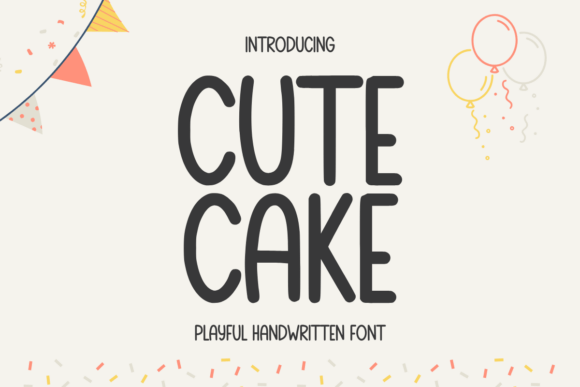
Cute Cake: A Whimsical Handwritten Font
Imagine opening your planner and seeing cheerful, bouncy lettering that feels like it was written just for you—warm, personal, and full of quiet joy. That’s the magic of Cute Cake: a thoughtfully crafted handwritten font designed to bring charm and authenticity to everyday creative work. It’s not overly polished or rigid—it breathes, curves, and flows like real handwriting, with subtle variations in stroke weight, natural entry/exit strokes, and gentle irregularities that make each character feel alive.
What Makes Cute Cake Stand Out
Unlike many script fonts that lean heavily into formality or flashiness, Cute Cake balances playfulness with usability. Its letters have soft edges, rounded terminals, and a relaxed rhythm—like notes jotted down during a cozy morning coffee. There are no sharp angles or dramatic flourishes that distract from readability. Instead, it offers warmth without sacrificing clarity—even at smaller sizes on printed stationery or digital screens.
It includes standard Latin characters, numerals, punctuation, and common diacritics, making it practical for English-language projects right out of the box. And because it’s carefully spaced and kerned, words flow smoothly without awkward gaps or collisions—a small but meaningful detail that saves time when designing.
Where Cute Cake Fits Into Real Life
Whether you’re sketching ideas in a bullet journal or formatting a printable habit tracker, Cute Cake adds personality without overwhelming the content. Its organic design supports intentionality—not just decoration. You’ll notice how headings in this font invite attention, while body text stays friendly and approachable.
- Planners & Journals: Use it for weekly headers, habit checklists, or inspirational quotes—giving structure a gentle, uplifting tone.
- Stationery & Notepads: Print custom thank-you cards, gift tags, or sticky-note sets where legibility and charm matter equally.
- KDP Interiors: From guided journals to themed activity books, Cute Cake helps self-published authors create interiors that feel cohesive, inviting, and professionally finished.
- Digital Planners: Works beautifully in apps like GoodNotes or Notability—especially when paired with light backgrounds and clean layouts.
A freelance educator might use Cute Cake for printable classroom handouts that feel less formal and more encouraging. A small business owner could apply it to product labels or packaging inserts to reinforce a handmade, caring brand voice. Even someone building a simple blog or Instagram carousel might choose it for overlay text—adding visual consistency without needing graphic design experience.
Why People Choose Cute Cake (and When It Might Not Be Right)
Most users turn to Cute Cake because they want their projects to feel human—not generic. It bridges the gap between “handmade” and “professional,” offering an accessible way to express creativity without mastering calligraphy or illustration.
That said, it’s worth keeping a few things in mind before diving in:
- Readability at small sizes: While highly legible, extremely tight spacing or tiny point sizes (under 10pt in print) may reduce clarity—especially for long paragraphs. Reserve it for headings, short labels, or medium-length captions.
- Consistency across platforms: As with any font, rendering can vary slightly between devices and software. Always preview in your final output environment—whether that’s a PDF export, KDP preview, or mobile app.
- Licensing scope: Check the license details before using Cute Cake commercially—for example, embedding in client websites, selling physical goods with the font applied, or distributing editable templates. Most versions allow broad personal and commercial use, but restrictions may apply to certain distribution models.
Getting Started Is Simple
You don’t need design training to begin using Cute Cake. Install it like any other font on your computer (Mac or Windows), then select it in your favorite tools—Canva, Google Docs, Adobe Express, Microsoft Word, or even Apple Pages. For best results, pair it with clean sans-serif fonts (like Montserrat or Inter) for contrast and hierarchy.
Try this beginner-friendly combo: use Cute Cake for section titles and motivational phrases, and a neutral sans-serif for instructions, dates, or checkboxes. This keeps your layout balanced—whimsical where it matters, clear where it counts.
If you're designing for print—like a custom notebook or KDP interior—test a single-page proof first. Pay attention to ink coverage, especially if printing at home. The soft curves and moderate contrast of Cute Cake tend to hold up well on matte paper, avoiding the “washed out” look some delicate scripts suffer from.
A Font With Quiet Confidence
Cute Cake doesn’t shout. It smiles. It invites. It makes routine feel special—not by changing what you do, but by changing how it feels to do it. That’s why so many people return to it again and again: for planners that spark joy, for journals that feel like safe spaces, for products that reflect care in every detail.
It’s also a reminder that typography isn’t just about function—it’s about mood, memory, and meaning. A well-chosen font like Cute Cake quietly reinforces your intentions: to slow down, to celebrate small wins, to build something meaningful, one page at a time.
So whether you're sketching your first habit tracker or launching your tenth KDP journal, consider letting Cute Cake be the gentle voice behind your words—the kind that makes people pause, smile, and reach for their pen.