Cherished Togetherne: A Playful Sans-Serif for Thoughtful Design Choices
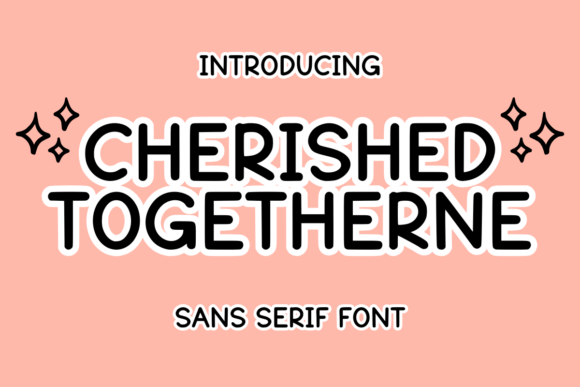
Cherished Togetherne is a carefully crafted sans-serif font that balances approachability with intentionality. It’s not built for headlines or branding systems—it’s designed for moments of quiet utility and personal expression. Its rounded terminals, gentle x-height, and open counters give it warmth without sacrificing legibility. Unlike many playful fonts that lean heavily into whimsy or hand-drawn irregularity, Cherished Togetherne maintains structural consistency across weights and characters, making it reliable for extended reading in planners, journals, and educational printables.
What Sets Cherished Togetherne Apart
Many sans-serifs labeled “playful” prioritize personality over practicality—think exaggerated proportions, uneven stroke contrast, or inconsistent spacing. Cherished Togetherne avoids those extremes. Its playfulness emerges through subtle design choices: soft corners on letters like a, c, and e; a slightly relaxed rhythm in lowercase forms; and just enough variation in curve tension to feel human-made, not algorithmically smoothed. That nuance makes it especially effective in contexts where tone matters as much as function—like a teacher’s classroom handout meant to feel inviting, or a weekly planner page designed to reduce cognitive load rather than add visual noise.
It’s also optimized for real-world production use. Kerning pairs are thoughtfully adjusted for common word combinations in English, and the character set includes standard punctuation, numerals with lining and old-style figures, and basic diacritics—enough for multilingual journaling or bilingual classroom materials without requiring workarounds. Unlike some decorative fonts that omit essential glyphs or lack OpenType features, Cherished Togetherne ships ready for everyday application in tools like Adobe InDesign, Canva, or Affinity Publisher.
Fitting Into Real Workflows
Where Cherished Togetherne shines most is in projects that sit at the intersection of utility and emotional resonance. Consider these examples:
- A homeschool parent creating custom spelling worksheets: Cherished Togetherne’s clarity supports early readers, while its friendly shape keeps pages from feeling sterile or overly academic.
- A small-business owner designing printable gratitude journals for digital download: The font conveys sincerity and calm without leaning into clichéd “spiritual” aesthetics.
- An educator building editable Google Slides templates for student reflection prompts: Its even spacing and generous letterfit prevent text overflow issues when users edit content.
- A self-publisher formatting a KDP interior for a guided bullet journal: It holds up well at smaller sizes (10–12 pt) on matte paper, avoiding the blurriness or ink spread sometimes seen with ultra-light or ultra-condensed alternatives.
In each case, the choice isn’t about novelty—it’s about alignment. Cherished Togetherne supports the goal without drawing attention to itself. That’s a meaningful distinction when evaluating fonts for functional documents.
When It Fits—and When It Doesn’t
Cherished Togetherne excels in environments where readability, tone, and reproducibility matter more than stylistic dominance. But it’s not universally suited. For example:
- Long-form editorial text: While legible, it lacks the refined vertical metrics and narrow inter-character spacing of text-optimized serif or humanist sans families (e.g., Merriweather or Lato). Extended paragraphs in books or newsletters may benefit more from those options.
- Digital interfaces with strict accessibility requirements: Though clear, its rounded shapes slightly reduce character distinctiveness at very small sizes (<9 pt) on low-resolution screens. Fonts designed explicitly for UI—like Inter or Roboto—often include enhanced contrast and larger touch targets.
- Branding systems needing strong visual hierarchy: Cherished Togetherne offers limited weight variation (typically Regular and Bold). If your project requires fine-grained typographic control—light captions, medium body, semibold subheads, bold callouts—you’ll likely need to supplement or choose a more expansive family.
That doesn’t make it “lesser.” It simply means its strengths are contextual. Its value lies in doing a specific set of things well—not everything.
Comparing With Common Alternatives
Designers often consider several categories when selecting a friendly, functional sans-serif: humanist sans fonts (like Nunito or Quicksand), geometric options (such as Montserrat or Poppins), and script-adjacent sans-serifs (like Pacifico or Caveat). Cherished Togetherne sits closest to the first group—but with key differences.
Nunito, for instance, shares similar warmth and openness but leans more neutral and widely tested in academic settings. Quicksand feels bolder and more condensed, which can enhance impact in headings but sometimes reduces flow in running text. Cherished Togetherne occupies a middle ground: friendlier than Nunito, more even and predictable than Quicksand, and significantly more legible than script-leaning alternatives at small sizes.
Compared to free Google Fonts, Cherished Togetherne also reflects deeper attention to spacing consistency across languages and use cases. Many free options rely on automated hinting or generic metric tables, leading to uneven line heights or awkward hyphenation in multilingual documents—a detail that matters when preparing bilingual planners or ESL workbooks.
Practical Decision Factors
If you’re weighing Cherished Togetherne against other options, consider these grounded questions:
- What’s the primary output format? If you’re printing physical notebooks, journals, or greeting cards—especially on uncoated or textured paper—Cherished Togetherne’s robust outlines and generous spacing help maintain clarity. For high-DPI screen-only use, other fonts may offer tighter rendering control.
- How much editing will users do? If your template or printable will be edited frequently (e.g., daily planner pages reused weekly), consistent spacing and predictable line breaks matter more than decorative flair. Cherished Togetherne handles dynamic text input reliably.
- Is tone part of the deliverable? In education, mental wellness, or creative coaching spaces, typography contributes to perceived empathy. A font that feels quietly supportive—not clinical or overly casual—can reinforce messaging without words.
- What’s your production timeline? Because Cherished Togetherne includes full language support and pre-tuned spacing, it reduces time spent adjusting tracking, kerning, or glyph substitutions—valuable when iterating quickly across multiple planner layouts or workbook versions.
None of these factors alone dictate a choice. But together, they help clarify whether Cherished Togetherne aligns with your actual constraints—not just aesthetic preferences.
A Resource, Not a Solution
Cherished Togetherne is best understood as one thoughtful tool among many—not a universal fix. Its strength lies in supporting intention: the intention to make a student feel welcomed, to help someone stay organized without friction, or to create something personal that still feels polished. It works because it respects the user’s time and attention, both as a designer and as an end reader.
That said, if your project demands extreme scalability (from 8 pt footnotes to 72 pt posters), multilingual typesetting beyond Western European languages, or integration into complex variable font systems, you may find greater flexibility elsewhere. And that’s okay. Good typography practice starts with matching capability to need—not chasing novelty or defaulting to what’s trending.
For educators building lesson resources, creators designing printable journals, or professionals developing internal planning tools, Cherished Togetherne offers a rare balance: warmth without fuzziness, charm without compromise, and versatility grounded in real use—not theoretical appeal.