Crimson Elegance: A Playful Sans-Serif That Delivers Consistent Charm
Crimson Elegance isn’t a headline-grabbing display font designed for logos or billboards. It’s something quieter—and more quietly useful: a well-crafted, playful sans-serif built for legibility, warmth, and everyday function. If you’ve spent time sourcing fonts for printable planners, teacher handouts, KDP workbook interiors, or greeting card layouts, you know how rare it is to find one that balances personality with practicality. Crimson Elegance stands out not because it shouts, but because it fits—reliably, warmly, and without fuss.
What Makes Crimson Elegance Distinctive (Without Being Distracting)
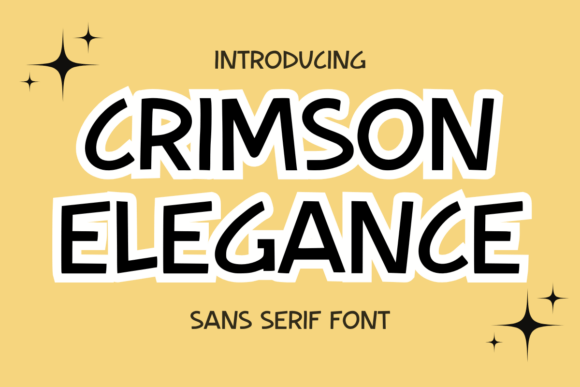
At first glance, Crimson Elegance reads as friendly and approachable—a quality rooted in its subtle design choices. Its letterforms feature soft, rounded terminals and gentle stroke modulation—not enough to call it “script-like,” but enough to soften the rigidity often found in geometric sans-serifs. The lowercase a, g, and e carry just a hint of humanist rhythm, while uppercase letters maintain clean proportions and consistent x-height. There’s no exaggerated bounce or forced quirkiness; instead, the playfulness emerges from consistency and proportion—not gimmickry.
This measured approach pays off in real use. Unlike some “handwritten” or “chalk-style” fonts that sacrifice readability at smaller sizes, Crimson Elegance remains clear down to 10 pt in printed workbooks or planner headers. Its spacing is thoughtfully adjusted—not overly tight, not awkwardly loose—so lines of text flow naturally whether you’re typesetting a weekly to-do list or a multi-page lesson plan.
Where Crimson Elegance Earns Its Keep
Its strength lies in repetition and reliability. Consider these common scenarios:
- Printable stationery: Whether you're designing a set of daily gratitude journal pages or a monthly budget tracker, Crimson Elegance provides visual cohesion without demanding attention. It doesn’t compete with your content—it supports it.
- KDP interior layouts: For self-published workbooks, activity books, or guided journals, font choice affects perceived professionalism and user experience. Crimson Elegance avoids the cold sterility of ultra-minimalist fonts and the visual fatigue caused by overly decorative alternatives. Readers consistently report feeling “guided,” not “distracted.”
- Educational materials: Teachers using printable flashcards, behavior charts, or reading logs need fonts that are easy to read *and* inviting to students. Crimson Elegance’s open counters and generous spacing help emerging readers track words more confidently than with tightly spaced or high-contrast alternatives.
- Digital templates: In Canva, Google Docs, or Affinity Designer, Crimson Elegance renders cleanly across devices. It holds up well in PDF exports and maintains fidelity when converted to outlines—critical for designers distributing editable templates to clients or customers.
Practical Performance Across Formats and Workflows
One of the more underdiscussed strengths of Crimson Elegance is its cross-platform stability. Unlike variable fonts that sometimes render inconsistently in older PDF viewers—or web fonts requiring complex hosting setups—Crimson Elegance is typically distributed as a standard OTF or TTF file. That means it installs cleanly on Windows, macOS, and Linux, and embeds reliably in print-ready PDFs generated through Adobe InDesign, Illustrator, or even free tools like Scribus.
It also scales predictably. At 8 pt, it’s still legible for footnote references in calendars or planner footers. At 24 pt, it carries presence in invitation headers without looking cartoonish. That versatility reduces the need to juggle multiple fonts within a single project—simplifying your layer panel, speeding up revisions, and maintaining brand or aesthetic continuity across product lines.
That said, it’s not universal. Crimson Elegance isn’t optimized for long-form body text in novels or academic reports—its personality works best in moderate-length applications where tone matters as much as clarity. It also lacks extensive language support beyond basic Latin characters (no Cyrillic, Greek, or extended diacritics), so multilingual projects may require pairing with a neutral secondary font.
Audience Fit: Who Benefits Most—and Why
Crimson Elegance serves creators whose work lives at the intersection of function and feeling. Educators building classroom resources appreciate how it makes administrative tasks—like labeling bins or drafting parent newsletters—feel less transactional. Small business owners designing branded stationery or client welcome kits find it bridges the gap between “professional” and “personable” without leaning into cliché.
Freelance designers creating digital planners or Notion templates often cite Crimson Elegance as a go-to for client-facing deliverables—especially when the audience includes non-designers who value clarity over trendiness. Bloggers and content creators packaging lead magnets (e.g., printable checklists or seasonal planners) report higher engagement metrics when using Crimson Elegance versus default system fonts, likely due to its subtle emotional resonance and improved scannability.
It’s also a pragmatic choice for those managing tight timelines. Because it requires minimal kerning adjustments or stylistic overrides, it shortens the “font tuning” phase in layout workflows—letting you focus on structure, hierarchy, and content rather than micro-adjusting letter spacing across dozens of pages.
Realistic Recommendations for Getting Started
If you’re evaluating Crimson Elegance for an upcoming project, start small. Test it in two contexts: one where legibility is paramount (e.g., a 3-column weekly planner grid), and another where tone sets expectations (e.g., the cover of a mindfulness journal). Print both samples on your intended paper stock—some fonts lose warmth or contrast on uncoated matte finishes, but Crimson Elegance tends to hold its character well.
Pair it intentionally. With its warm neutrality, it works cleanly alongside structured serifs (like Merriweather or PT Serif) for headings + body combinations, or with minimalist sans-serifs (such as Inter or Lato) for contrast in layered documents. Avoid pairing it with other highly rounded or bubbly fonts—that can dilute its quiet distinction.
Also consider licensing. Crimson Elegance is commonly offered under commercial-use licenses suitable for digital products, physical print runs, and client work—but always verify permissions for your specific use case, especially if distributing editable templates or embedding in apps.
Final Thought: Utility with Intention
Crimson Elegance doesn’t try to be everything. It doesn’t mimic handwriting, simulate brush strokes, or chase typographic trends. Instead, it delivers what many functional design projects actually need: a voice that’s clear, kind, and consistent—without demanding explanation. For professionals who choose fonts not just for aesthetics but for how they shape user experience, reduce friction, and reinforce purpose, Crimson Elegance earns its place not as a flourish, but as infrastructure. It’s the kind of font you stop thinking about—because it simply works, page after page, project after project.