Santa Concept: A Playful Sans-Serif That Fits Real Workflows
Fonts do more than spell out words—they shape tone, guide attention, and quietly influence how people engage with your content. Santa Concept stands out not because it’s flashy or technically complex, but because it meets a growing need: clarity with warmth. It’s a playful sans-serif designed for legibility at small sizes, flexibility across formats, and an approachable personality that doesn’t sacrifice professionalism.
Why a “Playful” Font Is Showing Up in More Serious Places
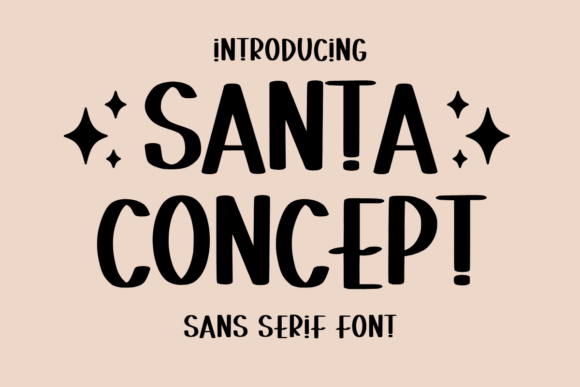
Over the past five years, we’ve seen a quiet shift in design expectations—especially among educators, independent creators, and small-business owners. People no longer default to ultra-minimalist or corporate-feeling typefaces when building resources meant for real human use. Instead, they’re choosing fonts that signal care, accessibility, and intentionality. Santa Concept fits here naturally: its rounded terminals, open counters, and consistent stroke weight make it easy to read on screen and in print, while its gentle curves soften rigid layouts without looking childish.
This isn’t about nostalgia or holiday themes—it’s about functional friendliness. Teachers selecting fonts for student handouts want something that feels inviting but still supports focus. KDP authors formatting workbooks or planners need a typeface that holds up across dozens of pages without visual fatigue. Bloggers designing printable checklists or habit trackers benefit from a font that reads clearly at 10 pt—and still looks intentional at 24 pt on a cover.
Evolving Beyond “Cute” Into Context-Aware Design
Santa Concept reflects how digital tools and creative habits have matured. Five years ago, many printable templates leaned heavily on script fonts or overly decorative options—charming in isolation, but impractical for dense content. Today’s users expect versatility: one font family that works equally well in a classroom worksheet, a client-facing proposal, and a personal journal page. Santa Concept delivers that balance—not by trying to be everything, but by excelling where it matters most: readability, rhythm, and emotional resonance.
Consider how often you switch between devices and output methods. You might draft a planner layout on a tablet, tweak spacing on a laptop, then print a test page on home inkjet paper. Santa Concept’s even spacing and moderate x-height help maintain consistency across those transitions. Its lowercase ‘a’ and ‘g’ are unambiguous, reducing misreading in handwritten-style notes or fill-in-the-blank exercises. And because it’s built as a true sans-serif (not a modified serif or hand-drawn imitation), it scales cleanly in SVG exports, PDFs, and web embeds—no pixelation, no awkward hinting issues.
Where Santa Concept Fits Into Modern Creative Practice
It’s not just about aesthetics—it’s about workflow efficiency. Freelancers building Canva templates, educators preparing Google Slides lesson kits, or Etsy sellers designing printable calendars all face the same constraint: time. Santa Concept reduces friction. There’s no need to pair it with a secondary font for body text; its regular and bold weights offer enough contrast for hierarchy without introducing visual noise. That means faster mockups, fewer revision rounds, and more confidence when sharing files with clients or students.
Real-world examples show this in action:
- A homeschool parent uses Santa Concept for weekly assignment sheets—students report fewer questions about instructions, and parents appreciate the clean layout when printing double-sided.
- A wellness coach builds habit-tracking journals in Notion, then exports them as branded PDFs. Santa Concept’s friendly tone reinforces their “progress over perfection” messaging without undermining credibility.
- An indie publisher formats KDP interiors for children’s activity books. The font stays legible in grayscale printing, avoids crowding in tight grid layouts, and aligns with age-appropriate design standards without leaning into cartoonish clichés.
Designing With Intention, Not Just Decoration
There’s a subtle but important distinction between using a font “because it’s fun” and using it “because it serves the user.” Santa Concept earns its place in serious projects precisely because it prioritizes function alongside expression. Its letterforms avoid excessive quirkiness—no exaggerated swashes, no inconsistent baseline alignment, no unpredictable kerning traps. That reliability makes it a safe choice for documents where accuracy matters: safety checklists, medication logs, bilingual flashcards, or multistep craft instructions.
This is especially relevant as more professionals move toward hybrid workflows—blending digital tools with analog outputs. Think of a marketing consultant who sketches campaign ideas in a physical notebook, then transfers key points into a Notion dashboard, and finally shares a polished one-pager with a client. Santa Concept bridges those modes. It feels natural in handwriting-inspired layouts, yet structured enough for data-heavy tables or bullet-point summaries.
Practical Tips for Getting the Most From Santa Concept
You don’t need advanced typography knowledge to use Santa Concept effectively—but a few grounded choices amplify its strengths:
- Stick to two weights. Use Regular for body text and Bold for headings or emphasis. Avoid Light or Black variants unless you’ve tested them at your intended size and medium—Santa Concept’s charm lies in its restraint, not density.
- Respect line height. At 12 pt, aim for 1.4–1.6 line spacing in printed materials and 1.5–1.7 in digital PDFs. Its open counters shine when given breathing room.
- Pair thoughtfully—if at all. While Santa Concept works solo, pairing it with a neutral monospace (like JetBrains Mono or IBM Plex Mono) adds subtle contrast for code snippets, timestamps, or technical annotations—without competing for attention.
- Test before scaling. If you’re designing for laser-cut wood signs, embroidery digitizing, or vinyl decals, verify how the font renders at extreme sizes. Its simplicity helps, but always proof at final output resolution.
Not a Trend—A Tool That Stays Useful
Fonts come and go in popularity, but the ones that endure solve recurring problems. Santa Concept doesn’t chase viral aesthetics. Instead, it answers practical questions creators ask daily: “Will this stay readable after three revisions?” “Does this feel welcoming without seeming unserious?” “Can I use this across my whole product line and keep visual cohesion?”
That utility explains its steady adoption across niches that rarely overlap—classroom teachers and productivity app developers, scrapbookers and SaaS founders, journal designers and nonprofit communicators. They’re not all choosing Santa Concept for the same reason, but they’re all solving similar challenges: making information easier to absorb, reducing cognitive load, and adding quiet humanity to functional design.
As tools become more powerful—and expectations for polished, personalized content rise—having a dependable, expressive typeface like Santa Concept isn’t a luxury. It’s part of working smarter: less time wrestling with formatting, more time focusing on what the content actually does for people.