Vector Decor: The Playful Sans-Serif That Fits Your Everyday Creative Work
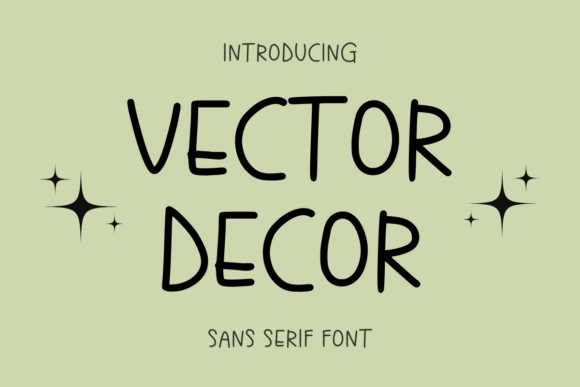
If you’ve ever spent ten minutes scrolling through font libraries trying to find something that feels both fresh and functional—something that doesn’t scream “corporate brochure” or “kindergarten worksheet”—you know how rare it is to land on a typeface that just works. Vector Decor is one of those rare finds: a clean, friendly sans-serif designed not for headlines or logos, but for the quiet, consistent moments where words meet paper—or screen—and need to feel human.
What Is Vector Decor, Really?
Vector Decor isn’t a display font meant for banners or social media graphics. It’s built for legibility at small sizes, rhythm in long lists, and warmth in personal touches. Its rounded terminals, gentle x-height, and open counters make it highly readable in printed planners, digital notebooks, and KDP interiors—even at 9–10 pt. Because it’s delivered as a vector-based font (OTF/TTF), it scales crisply across formats: whether you’re printing a 6×9 workbook or exporting a 300 dpi greeting card PDF, edges stay smooth and consistent.
Where People Actually Use Vector Decor—Not Just Where It *Could* Go
Real usage rarely matches stock photo captions. You won’t see Vector Decor on billboards—but you’ll spot it in places where clarity, charm, and quiet intention matter:
- Teachers building printable resources: A third-grade teacher uses Vector Decor for weekly behavior charts and reading logs—not because it’s “cute,” but because students recognize letterforms quickly, and parents find handouts approachable when reviewing progress at home.
- Freelance designers crafting Notion templates: They pair Vector Decor with subtle grid lines and soft color palettes for daily planning dashboards—its even spacing keeps checklists scannable, and its warmth avoids the sterile feel of system fonts like Inter or Helvetica.
- KDP authors formatting interior pages: For guided journals or habit trackers, Vector Decor provides enough personality to stand out from generic Amazon templates—without triggering algorithmic “low-quality” flags tied to overly decorative or hard-to-read fonts.
- Small business owners designing thank-you cards: A local florist adds Vector Decor to seasonal postcards alongside watercolor illustrations—it reads clearly on recycled paper stock, holds up when printed on home inkjets, and subtly reinforces brand tone: thoughtful, grounded, unhurried.
Why It Fits So Well Across So Many Contexts
The versatility isn’t accidental. Vector Decor balances three practical needs most working creatives juggle:
- Legibility under real conditions: It performs well on textured paper, low-resolution screens, and older printers—no thin strokes to disappear, no tight spacing to blur into gray mush.
- Emotional alignment without overstatement: It’s friendly but not childish, modern but not cold. That makes it useful for sensitive contexts—like mental health workbooks or caregiver planners—where tone matters as much as function.
- Technical flexibility: With full Latin character sets, standard ligatures, and basic OpenType features (like true fractions and superscript numbers), it handles everyday content—dates, bullet points, measurements, checkmarks—without needing workarounds.
Who Benefits Most—and How Their Needs Shape Usage
A high school art teacher using Vector Decor for sketchbook labels cares about durability: Will it survive repeated erasing? (Yes—the clean shapes don’t ghost when lightly penciled over.) A wedding planner typesetting invitation suites thinks about hierarchy: Can it support elegant yet unpretentious layering with a serif companion font? (Absolutely—its neutral weight pairs naturally with Garamond or Lora.) A blogger creating free downloadable planners asks: Does it embed reliably in PDFs shared via email? (It does—no missing glyphs or substitution warnings.)
Even hobbyists benefit quietly. Someone assembling a family recipe scrapbook might choose Vector Decor for ingredient lists—not for aesthetics alone, but because its consistent letter width helps align handwritten notes beside typed text. Or a remote worker redesigning their analog bullet journal may switch to Vector Decor for monthly spreads after realizing its lowercase “a” and “g” reduce visual fatigue during daily review.
Things to Consider Before You Use It
Vector Decor shines brightest when matched to its strengths—not forced into roles it wasn’t built for. Here’s what to keep in mind:
- It’s not a branding font: Don’t use it for logos, app icons, or primary website headers unless your brand voice centers on softness and accessibility above distinction. It won’t command attention like a bold grotesque—but it will hold attention gently.
- Check contrast in final output: On dark backgrounds or low-ink prints, test how its medium weight renders. Some users boost contrast slightly in design software or choose a bolder variant if available.
- Licensing matters for commercial use: If you’re bundling Vector Decor into editable Canva templates or selling printable kits, verify the license covers redistribution. Most versions allow this—but always confirm before scaling production.
- Pair it thoughtfully: It works beautifully with modest serifs (e.g., Cormorant Garamond for headings) or restrained geometric sans-serifs (e.g., Manrope for data tables). Avoid pairing with other playful fonts—that dilutes its quiet charm.
More Than Just a Font—A Small Tool for Consistent Care
In a world of rushed deliverables and template fatigue, Vector Decor serves a quieter purpose: helping people show up consistently in ways that feel aligned. A therapist printing session worksheets chooses it so clients feel welcomed, not assessed. A student designing their first study planner picks it because it makes daily review feel less like a chore and more like a ritual. A solopreneur updating their client onboarding packet selects it—not to impress, but to communicate care in the margins.
That’s the real utility of Vector Decor. It doesn’t solve big problems. It makes small interactions—reading a to-do list, filling out a journal prompt, sharing a handmade card—feel a little more intentional, a little more kind. And sometimes, especially on Tuesday mornings or during back-to-school season, that’s exactly what gets the work done.