Velvet Romance: The Handwritten Sans Serif That Elevates Everyday Design
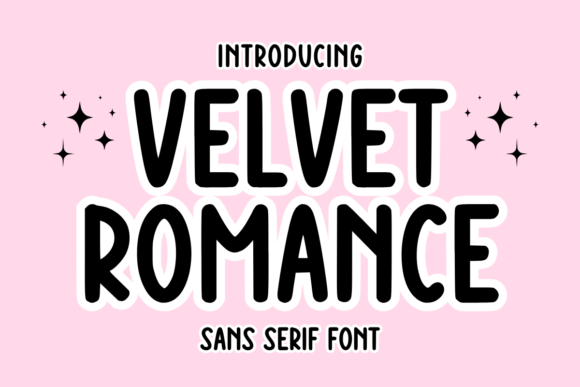
Velvet Romance isn’t just another script font—it’s a carefully balanced handwritten sans serif with warmth, rhythm, and quiet confidence. Designed to feel personal without sacrificing legibility, it bridges the gap between expressive handwriting and clean typographic structure. That’s why creators across niches—educators drafting lesson plans, indie authors formatting KDP interiors, small business owners designing greeting cards, or hobbyists assembling scrapbooks—reach for Velvet Romance when they want authenticity *and* polish.
Why It Stands Out (Beyond the “Cute” Factor)
Unlike many decorative scripts that blur into illegibility at small sizes or lose character in bold weight, Velvet Romance maintains its charm from 10 pt note headers to 48 pt cover titles. Its open counters, consistent x-height, and subtle baseline variation make it highly readable—even in dense planner layouts or multi-page workbooks. And because it’s a *sans serif* script (no flourishes or connecting strokes), it avoids the fatigue that often comes with overly ornate fonts in long-form text. You’ll notice it most where clarity matters: on weekly planner headers, journal prompts, printable habit trackers, or classroom handouts meant to be read—not just admired.
Mistake #1: Assuming It Works Like a Traditional Script
Some users download Velvet Romance expecting automatic ligatures or swash alternates—only to find it behaves like a standard OpenType font with no contextual substitutions. That’s intentional. Velvet Romance prioritizes consistency over variability, so each letterform stays true across platforms and software. If you’re counting on automatic stylistic sets (like in Adobe Fonts or Glyphs), you’ll be disappointed. Fix it: Use it as designed—pair it with a crisp, neutral sans serif (e.g., Inter, Lato, or Montserrat) for body text, and lean into its natural rhythm for headings, quotes, and callouts. No extra plugins or workarounds needed.
Mistake #2: Using It for Long Blocks of Body Text
Even though it’s highly legible, Velvet Romance isn’t built for paragraphs. Its personality shines in short bursts: journal titles, section dividers, quote pulls, or memo headers. Try using it for an entire page of instructions or a KDP interior chapter—and readability drops, especially on low-resolution e-ink screens or printed notebooks with thinner paper. Fix it: Reserve Velvet Romance for 1–3 lines max per use. For longer content, switch to a complementary serif or geometric sans. A good rule of thumb: if your reader needs to slow down to decode a word, it’s time to step back.
Mistake #3: Overlooking Licensing for Commercial Projects
Free versions of Velvet Romance sometimes circulate online—but these are often outdated, lack full character sets (no diacritics, no extended Latin support), or come with restrictive licenses. One educator discovered too late that the “free download” she used for 50+ printable classroom resources wasn’t cleared for resale on Teachers Pay Teachers. Her listings were removed, and she had to reformat everything in a rush. Fix it: Always verify licensing directly from the official source. Look for clear terms covering KDP interiors, digital downloads, physical products, and client work. If you’re selling planners or journals, confirm the license includes commercial redistribution—not just personal use.
Mistake #4: Ignoring Kerning and Tracking in Real Layouts
Velvet Romance has generous default spacing—but that doesn’t mean it’s set-and-forget. In tight spaces (like narrow notepad margins or compact calendar grids), letters can appear cramped. Conversely, in large display settings (e.g., a wedding invitation headline), default tracking may feel too airy. Fix it: Adjust tracking manually in your design tool. For body-sized headings (14–24 pt), try -10 to -20 units. For display sizes (36+ pt), +10 to +30 often enhances rhythm without sacrificing cohesion. Preview on actual paper or device screens—not just your monitor.
What to Check Before You Commit
- Character coverage: Does it include accented characters (é, ñ, ü), punctuation variants, and numerals that match your audience’s language? If you’re designing for bilingual journals or international KDP markets, missing glyphs will force awkward substitutions.
- File format & compatibility: Prefer OTF or TTF? Verify it loads cleanly in Canva, Affinity Publisher, Microsoft Word, and Google Docs (via upload). Some handwritten fonts render inconsistently in web-based tools—test before batch-designing.
- Weight options: Velvet Romance is typically offered in a single upright weight. If you need bold or italic variants for hierarchy, plan to pair it intentionally—not rely on faux-bold styling, which distorts its delicate proportions.
- Real-world samples: Don’t just glance at the preview image. Download a trial or test PDF that shows how it handles real content: a to-do list with checkboxes, a monthly calendar grid, or a two-column workbook layout.
Better Pairings—Not Just “Safe” Ones
Velvet Romance pairs beautifully with typefaces that ground its playfulness without competing. Avoid other high-contrast or overly decorative fonts—they’ll clash, not complement. Instead, try:
- For KDP interiors: IBM Plex Sans—its humanist warmth matches Velvet Romance’s tone, and its extensive weights let you build clear visual hierarchy.
- For printable planners: Manrope—a friendly, highly legible variable sans that scales smoothly from tiny date boxes to weekly summary headers.
- For greeting cards or invitations: Work Sans—clean, slightly rounded, and engineered for screen and print. Its even color balances Velvet Romance’s organic texture.
Remember: pairing isn’t about contrast for contrast’s sake. It’s about harmony that serves your reader. Velvet Romance invites closeness—so choose companions that extend that invitation, not interrupt it.
A Final Thought: Let Personality Serve Purpose
Velvet Romance earns its name not because it’s soft or indulgent—but because it carries intention. Every curve, every tilt, every space is calibrated to make written words feel seen, considered, and gently held. That’s why it works so well in journals, lesson plans, and heartfelt notes: it supports meaning instead of overshadowing it. Choose it when you want your design to say, “This matters—and so do you.” Then use it thoughtfully, test it honestly, and let its quiet confidence do the rest.