Abstract Srars: A Playful Handwritten Sans-Serif Font for Everyday Creativity
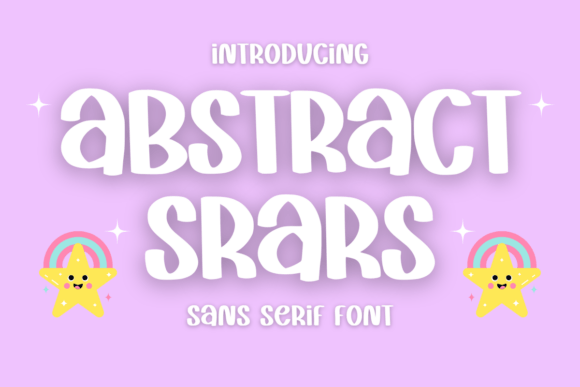
Abstract Srars is a handwritten sans-serif typeface designed with intentional charm and quiet versatility. Unlike many script fonts that prioritize flourish over function—or rigid sans-serifs that favor neutrality over personality—Abstract Srars occupies a thoughtful middle ground. Its letters are rounded, gently irregular, and lightly weighted, evoking the warmth of pen-on-paper without sacrificing legibility at small sizes or on screen. It’s not a calligraphic display font meant only for headlines, nor is it a utilitarian workhorse built for dense body text. Instead, Abstract Srars excels where personality meets practicality: in journals, planners, printable notes, greeting cards, and low-content KDP interiors.
What Sets Abstract Srars Apart
At its core, Abstract Srars distinguishes itself through balance. Its lowercase forms have subtle variation—slight shifts in stroke width, soft terminals, and relaxed spacing—that suggest human touch, yet its consistent x-height and open counters keep it highly readable. Capital letters avoid exaggerated swashes; instead, they echo the friendly rhythm of the lowercase, making the font feel cohesive across mixed-case settings like titles, headers, and short paragraphs.
This design philosophy supports real-world use. For example, when used in a weekly planner template, Abstract Srars adds visual interest to section headers (“Meals,” “Appointments,” “Gratitude”) without competing with handwritten entries beneath. In a printable habit tracker, its light contrast allows checkboxes and dates to remain clear while the font itself conveys approachability—not distraction. That duality—expressive yet functional—is what makes Abstract Srars stand out among handwritten sans options.
How It Compares to Similar Fonts
Handwritten sans-serif fonts fall along a spectrum—from ultra-casual doodle-like styles to tightly engineered, nearly geometric interpretations. Abstract Srars sits toward the center: more structured than freeform sketch fonts (which often sacrifice consistency across weights or characters), but looser and warmer than minimalist sans-serifs with uniform strokes and strict proportions.
Compared to bolder, high-contrast handwritten fonts, Abstract Srars offers better scalability. It remains legible down to 10–12 pt in printed notebooks or digital PDFs—important for KDP interior pages where readers may zoom or print at varying resolutions. In contrast, some expressive handwritten fonts lose clarity below 14 pt or require careful kerning adjustments for even basic phrases.
It also avoids the “overly cutesy” trap common in playful fonts. There are no exaggerated tails, cartoonish blobs, or forced asymmetry that can date quickly or limit professional contexts. Teachers using Abstract Srars in classroom handouts, for instance, find it engaging for students without appearing juvenile. Similarly, wellness coaches incorporating it into habit journal templates report that clients perceive the tone as supportive—not infantilizing.
Strengths in Practice
- Print-friendly consistency: Performs well across inkjet, laser, and PDF export—no unexpected thinning or blurring of strokes.
- Low visual fatigue: Rounded shapes and generous letter spacing reduce eye strain during extended writing or reading sessions.
- Adaptable tone: Works equally well for lighthearted scrapbook captions and gentle motivational quotes in self-care workbooks.
- Template-ready: Includes standard Latin character sets, numerals, and basic punctuation—no missing glyphs mid-project.
Where Abstract Srars Fits—and Where It Doesn’t
Abstract Srars shines in projects where voice matters but volume doesn’t. Think: the header of a monthly reflection page, the title of a gratitude journal, or the label on a printable mood tracker. It supports intentionality without demanding attention.
It’s less suited for long-form body text—say, a 200-page guided journal with dense prompts—where a more neutral, highly legible serif or sans-serif would sustain readability over time. Likewise, if your project requires multilingual support beyond Western European languages, you’ll want to verify glyph coverage before committing, as Abstract Srars prioritizes breadth of stylistic utility over exhaustive language extension.
For designers building multipage KDP interiors, Abstract Srars pairs effectively with simple companion fonts: a clean, low-contrast sans-serif for instructions or captions, or a modest serif for pull quotes. Its restrained energy means it rarely clashes—but it also doesn’t dominate. That makes it a strong supporting player, not a solo act.
Realistic Use Cases
- A teacher creating printable behavior charts uses Abstract Srars for category headers (“Focus,” “Kindness,” “Effort”)—keeping them warm and encouraging while leaving space for student handwriting underneath.
- A stationery designer builds a set of wedding invitation suites: Abstract Srars appears on the main names and date, paired with a delicate serif for addresses and RSVP details—balancing personality with formality.
- A digital planner creator applies Abstract Srars to tab labels and daily headers in Notion or GoodNotes templates, ensuring visual continuity across devices without compromising tap targets or scroll speed.
- An indie author developing a low-content gratitude journal selects Abstract Srars for section dividers and inspirational prompts—adding tactile appeal to an otherwise minimal layout.
Decision Factors to Consider
Choosing Abstract Srars depends less on trend alignment and more on fit with your workflow and audience expectations. Ask yourself:
- Is legibility at small sizes critical? If your templates include fine-print instructions or compact grids, test Abstract Srars at 9–11 pt in your intended output format.
- Do you need multiple weights or stylistic alternates? Abstract Srars typically ships as a single weight—ideal for simplicity, but limiting if you rely on bold/italic differentiation for hierarchy.
- How much customization do you expect? While it supports OpenType features like ligatures or contextual alternates in some versions, it’s not built for deep typographic experimentation—think refinement, not reinvention.
- What’s your production environment? If you’re working in Canva or Google Docs, confirm compatibility and rendering behavior—some platforms compress or oversimplify subtle stroke variations.
When Another Option Might Be Better
Abstract Srars isn’t the default choice for every creative need. If your project demands sharp contrast for branding (e.g., a podcast logo or course cover), a more distinctive display font may communicate authority more directly. If you’re designing for accessibility-first contexts—such as learning materials for neurodivergent users—a font with higher x-height, wider apertures, and stricter spacing standards may be preferable.
Similarly, if your workflow relies heavily on variable font technology—adjusting weight, width, or slant dynamically—Abstract Srars, as a static font family, won’t accommodate those controls. In those cases, evaluating variable alternatives with similar warmth becomes a more relevant comparison point.
In short, Abstract Srars earns its place not by being the most versatile font overall, but by being consistently well-suited to a specific, widely shared need: adding sincerity and softness to everyday written spaces—without asking for extra effort from the user or the reader.