Lovers Moment: A Handwritten Sans-Serif Font for Thoughtful, Everyday Creativity
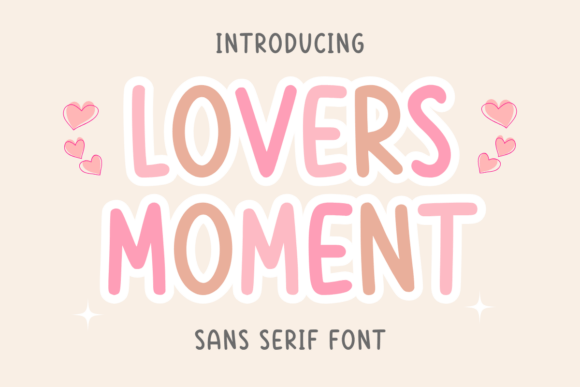
Lovers Moment is a carefully crafted handwritten sans-serif font that balances warmth and clarity. It’s not overly ornate, nor is it rigidly geometric—it sits comfortably between the spontaneity of pen-on-paper and the legibility required for functional design. Its letters flow with gentle variation in stroke weight and subtle irregularities, evoking the quiet intention behind a personal note or a hand-sketched planner layout. That balance is what makes Lovers Moment distinctive: it feels human without sacrificing readability at small sizes or in dense layouts.
What Sets Lovers Moment Apart from Other Handwritten Fonts
Many handwritten fonts fall into one of two categories: highly decorative scripts meant for headlines and logos, or ultra-minimalist “hand-drawn” sans-serifs that lose character at smaller point sizes. Lovers Moment avoids both extremes. Its lowercase ‘a’, ‘g’, and ‘y’ feature open, friendly shapes—not tightly looped or exaggerated—making them easy to distinguish in running text. Uppercase letters maintain presence without dominating; they’re confident but never shouty. The spacing is generous, supporting comfortable reading in longer passages—a rare strength among fonts in this style.
This practicality extends to its technical execution. Lovers Moment includes full Latin character sets, standard punctuation, numerals with consistent x-height alignment, and basic OpenType features like ligatures and stylistic alternates—enough to add nuance without requiring advanced typesetting knowledge. It’s built for real-world use, not just visual appeal.
Fitting Into Your Creative Workflow: Where Lovers Moment Excels
Lovers Moment shines in contexts where tone matters as much as function. For KDP interior designers, it offers a cohesive, inviting voice for journal prompts, reflection pages, and guided exercises—especially in self-help, mindfulness, or habit-tracking titles. Unlike monoline scripts that blur when printed on textured paper, its moderate contrast holds up well in grayscale or low-ink printing scenarios common in paperback production.
In physical crafts, it supports consistency across formats. Whether you’re designing a printable weekly planner, a set of themed greeting cards, or a classroom calendar for elementary students, Lovers Moment scales cleanly from 8 pt (for compact to-do lists) to 36 pt (for invitation headers). Its whimsical touch reads as approachable rather than childish—making it equally viable for adult scrapbooking kits and teacher resource bundles aimed at grades 3–6.
For educators and curriculum designers, it’s particularly effective in materials meant to feel supportive rather than authoritative: student goal trackers, behavior reflection sheets, or editable bulletin board labels. The font quietly signals “this is yours to fill, adapt, and own”—a subtle but meaningful cue in learning environments.
Comparing Practical Fit: When Lovers Moment Aligns—and When It Might Not
Not every project benefits from handwriting-inspired type. If your work requires strict typographic neutrality—like legal disclaimers, technical documentation, or data-heavy dashboards—Lovers Moment’s personality may distract rather than support. Similarly, multilingual projects needing extended Cyrillic, Greek, or Asian language support will need supplemental fonts, as Lovers Moment focuses on Western European languages.
Compare it to bolder brush-script alternatives: those often excel in short bursts (a logo, a banner), but fatigue quickly in body copy. Lovers Moment’s lower contrast and open letterforms sustain attention over paragraphs—ideal for diary templates or journaling spreads where users spend minutes, not seconds, engaging with the text.
It also differs meaningfully from rigid, geometric sans-serifs used in productivity apps. Those prioritize speed and uniformity; Lovers Moment prioritizes resonance. You wouldn’t choose it for a spreadsheet header—but you might choose it for the label beside it (“Your Weekly Intentions”) to soften the interface and invite engagement.
Real-World Use Cases and Tradeoffs
- Planner interiors: Works well for dated layouts and habit grids where clean lines meet expressive headings. Tradeoff: May require slight leading adjustment if paired with very tight grid lines—test print first.
- Greeting cards: Adds sincerity without cliché, especially for milestone moments (graduation, new parenthood, anniversaries). Tradeoff: Avoid pairing with overly busy backgrounds—its charm lives in breathing room.
- Teacher resources: Effective for editable PDF calendars and classroom job charts where clarity and warmth both matter. Tradeoff: Less suitable for high-frequency flashcards where rapid visual scanning is essential.
- Scrapbooking kits: Blends naturally with watercolor textures and washi tape elements. Tradeoff: Its light stroke weight means it won’t hold up against heavy distressing effects—reserve bold outlines for separate graphic layers.
Making the Choice: Does Lovers Moment Match Your Intent?
The decision isn’t about whether Lovers Moment is “good”—it’s about whether its particular blend of qualities matches what your project asks of typography. Ask yourself:
- Is the goal to make functional content feel more personal, not less precise?
- Will readers interact with this text over time—not just glance at it?
- Do you need a voice that feels grounded, unhurried, and quietly encouraging?
- Are you working within constraints (paper texture, ink limits, file size) where predictability matters?
If three or more answers are yes, Lovers Moment is likely a strong candidate. Its value emerges most clearly in iterative, repeat-use formats: a planner you’ll open weekly, a journal you revisit monthly, or classroom tools reused across semesters. In those cases, its consistency becomes part of the experience—not just decoration.
Conversely, if your priority is maximum scannability in fast-paced digital interfaces, broad multilingual coverage, or stark visual contrast for branding systems, other type families may serve better. There’s no universal “best”—only what fits the context, audience, and medium with minimal friction.
Testing and Integration Tips
Before committing to Lovers Moment across a full project, test it in your actual environment. Print a sample page of your intended layout—not just a font specimen—to assess how it behaves with your chosen paper stock and printer settings. Try it at 10 pt and 14 pt side-by-side in a real to-do list or journal prompt. Notice where spacing feels generous versus cramped, and where letterforms remain distinct under lighting conditions typical for your end user (e.g., dim bedside lamps for nighttime journaling).
When pairing with other fonts, lean into contrast: a sturdy, neutral sans-serif (like Inter or Source Sans) for captions or instructions creates helpful hierarchy without competing. Avoid pairing with other handwritten styles unless their rhythms differ significantly—one should lead, the other should support.
Lovers Moment doesn’t demand attention. It invites it—gently, consistently, and with quiet confidence. That restraint is its strength. For creators who value intention over ornamentation, and clarity over flash, it offers a reliable, expressive tool—not just another font, but a thoughtful design partner.