Giggly Friends: Playful, Polished & Purposeful
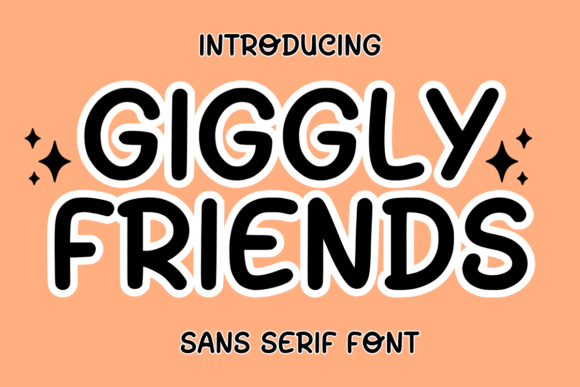
There’s a quiet magic in a font that feels like it remembers your childhood doodles—but still holds its own in a professional pitch deck or a best-selling KDP workbook. Giggly Friends is exactly that kind of typeface: a friendly, rounded sans-serif with gentle curves, open counters, and just enough personality to spark joy—without sacrificing clarity or structure. It’s not cartoonish. It’s not overly cutesy. It’s warm, approachable, and quietly confident—like the teacher who remembers your name on day one, or the planner that makes you *want* to write things down.
More Than Just “Cute”—A Font With Intentional Design
Look closely: the lowercase a has a soft, single-story shape; the g is friendly and looped; terminals taper gently rather than cutting off sharply. There’s generous x-height and consistent spacing—key traits that support readability at small sizes, especially in dense layouts like journal grids or weekly planner boxes. The weight sits comfortably between medium and bold—not so light it fades, not so heavy it overwhelms. That balance is why Giggly Friends works as both a display font (think greeting card headlines or Instagram story text) and functional body text (think workbook instructions or printable habit trackers).
It’s a premium font rooted in modern typography principles—but designed for real use, not theoretical elegance. No optical illusions, no forced quirks. Just clean lines, intentional rhythm, and a voice that says, “This matters—and so do you.”
Where Giggly Friends Earns Its Keep (Beyond the Obvious)
Yes, it shines in KDP interiors, greeting cards, and scrapbook kits—but its real strength lies in how thoughtfully it bridges personal and professional contexts. A small-batch candle brand uses Giggly Friends for ingredient labels and thank-you notes—softening the clinical tone of product copy without undermining trust. A school counselor prints emotion-tracking worksheets with it: kids recognize the tone instantly (“this is safe to fill out”), while administrators see consistency and care.
In editorial design, it adds warmth to sidebars in wellness blogs or educational newsletters—never competing with serif body text, but creating clear visual hierarchy. For social media graphics, it stands up well against busy backgrounds, especially when used in short bursts: “You’ve got this,” “Try again tomorrow,” “What made you smile today?” Its legibility holds up even at 24px on mobile screens, and its character set includes standard punctuation, numerals, and basic diacritics—no last-minute scrambling for accented characters mid-project.
Teachers use it for classroom posters and behavior charts because students read it faster and associate it with encouragement. Planners and notebook designers rely on it for dated headers and section dividers—it adds charm without cluttering the page. And yes, it’s licensed for commercial use, including resale in digital templates and physical printables, as long as you follow the included license terms (always review those before bundling into a Canva template pack or Etsy download).
Pairing It Right—Without Overthinking
You don’t need a font pairing toolkit to make Giggly Friends work. Start simple: pair it with a neutral, highly legible sans-serif like Inter, Lato, or Open Sans for body copy. Their clean geometry lets Giggly Friends breathe as a headline or accent. If your project leans more editorial—say, a mindfulness journal—you might contrast it with a gentle serif like Merriweather or Cormorant Garamond. The key isn’t contrast for contrast’s sake; it’s about supporting function. Use Giggly Friends where you want warmth and invitation (a call-to-action button, a quote box, a section title), and lean on your secondary font where readers need sustained focus (instructions, definitions, timelines).
Avoid pairing it with other playful fonts—two competing personalities dilute impact. And skip ultra-thin or distressed typefaces; they clash tonally and visually. When in doubt, test at actual size: print a sample page of your planner layout or snap a screenshot of your Instagram carousel. Does the hierarchy feel intuitive? Does the tone match your audience’s expectations—not just your aesthetic preferences?
Readability Isn’t Optional—It’s the Foundation
Here’s what experienced designers know: charm means nothing if people skip over your words. Giggly Friends earns its versatility because it was built with readability in mind—not as an afterthought, but as a core constraint. Its generous letter spacing prevents crowding in tight spaces like calendar cells or sticky-note mockups. Its uniform stroke width avoids visual fatigue in longer passages (yes, even in a 10-page workbook). And unlike many handwritten or script fonts, it doesn’t rely on context or familiarity to be understood—making it inclusive for neurodiverse users, ESL readers, and anyone scanning quickly.
That said, it’s not ideal for dense paragraphs in a 50,000-word novel—or legal disclaimers in 8pt type. Respect its sweet spot: 14–28pt for print, 18–36px for web and social. Test it in your actual environment: render a sample of your KDP interior in Kindle Previewer, or preview your Notion template with real content. Adjust tracking slightly if needed—but rarely kerning, since spacing is already well-optimized.
Final Thought: Choose With Context, Not Just Character
Giggly Friends isn’t a universal solution—but it *is* a highly reliable tool for specific, meaningful jobs. It’s the font you reach for when your goal isn’t to shout, but to connect. When your audience needs reassurance more than authority. When “professional” doesn’t mean “sterile,” and “playful” doesn’t mean “unserious.”
If your project lives at that intersection—whether it’s a therapist’s printable self-care kit, a boutique stationery line, a teacher’s classroom resource bundle, or a small business’s customer welcome sequence—Giggly Friends brings cohesion, warmth, and quiet professionalism. It doesn’t distract. It doesn’t demand attention. It simply makes the thing you made feel more human—and that, in the end, is the mark of thoughtful design.